
BY Anoop Bose.
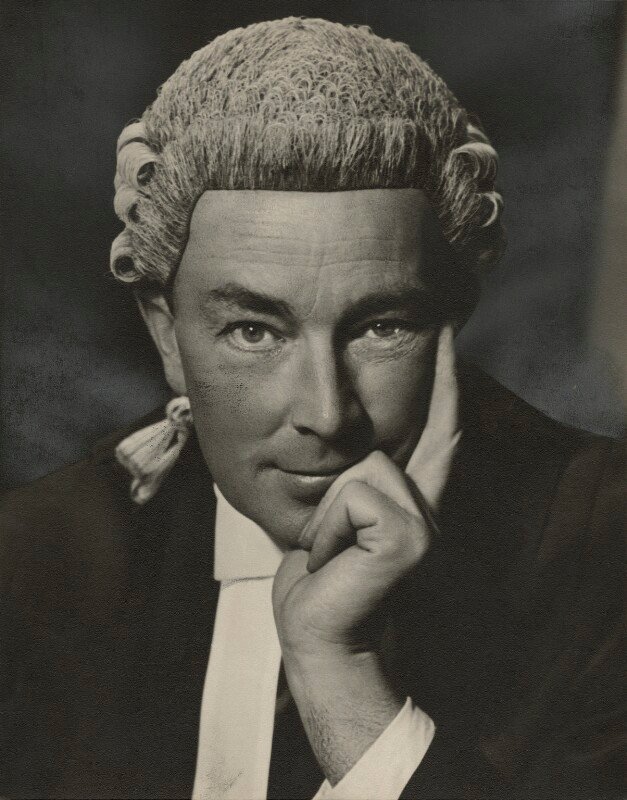
One of the greatest lawyers the world has ever known was Lord Hartley William Shawcross, the prodigious British barrister and politician and the lead British prosecutor at the Nuremberg War Crimes Tribunal.
Shawcross was born on 4th February,1902, in Giessen, Germany. His father John Shawcross, who belonged to a miller’s family in Rochdale, Greater Manchester, was a brilliant Oxford educated linguist and a venerated professor of English literature at the iconic Giessen University. His mother Hilda was an ardent suffragette. His parents were closely related to John Bright, the radical free trade protagonist, who served in two of the British Prime Minister William Ewart Gladstone’s cabinets, coined the phrase ‘England is the Mother of Parliaments’ and first used the expression ‘flogging a dead horse’ in the British Parliament.
Shortly after Shawcross’ birth, his parents returned to England. The family possessed a spacious cottage in Ashdown Forest, Sussex (the home of the fictional teddy bear Winnie-the-Pooh!), which Shawcross regarded as his real home in childhood. He received his elementary education at home and from a private tutor. His precocious knowledge of French and razor-sharp intellect earned him a coveted place as a day boy at the famed Dulwich College, London. Shawcross used to conscientiously cycle seven miles in the early morning to catch the train that steamed him to school. Whilst at school, Shawcross passionately preached socialism in the debating society. At the age tender of 16, he became a Labour party activist, serving as a ward secretary in Wandsworth, South London, and canvassed for the local Liberal candidate Joseph Havelock Wilson in the sensational 1918 ‘khaki’ election campaign of Britain’s kinetic war-time coalition Prime Minister David Lloyd George. He consciously decided not to follow in his father’s footsteps to Oxford. Instead, he chose to become a doctor. After taking a short course at the London School of Economics, he studied French at the University of Geneva before attending the historic St Bartholomew’s Hospital, London. When the Socialist International convened in Geneva in 1919 after the First World War, Shawcross offered his services as a translator to the British delegation, which included the future Prime Minister Ramsay MacDonald, the future Deputy Prime Minister Herbert Morrison and the firebrand trade unionist and Labour politician James Henry ‘Jim’ Thomas. On a steamer trip on the crystal clear blue waters of the spectacular Lake Geneva, Thomas induced him to enter politics and abandon medicine for law.
On his return to England, Shawcross studied for the Bar at the historic Gray’s Inn, known for its elysian gardens or ‘Walks’ where the legendary English parliamentarian and jurist Sir Francis Bacon used to plant ornamental trees, including the magnificent ‘Catalpa tree’ brought by the notable English explorer Sir Walter Raleigh all the way from the Bermudas. He gained first-class honours all the way and topped the Bar finals in 1925. Whilst preparing for the Bar finals, he worked as an agent for the eminent Solicitor and Labour Party politician Lewis Silkin. He also fell madly in love with Alberta Rosita Shyvers at a Gray’s Inn summer ball and they married on 24th May,1924 after a whirlwind romance. Shawcross’s initial earnings at the Bar were most exiguous and he could barely make two ends meet. He moved to Liverpool in 1927 where he accepted the post of a part-time lecturer in law at Liverpool University. He also joined the chambers of the audacious Barrister Sir George Justin Lynskey. There he prospered and commanded the largest junior practice on the Northern Circuit. In his maiden case, he was obliged to defend a man who had sold a parrot that refused to speak to its new owner. Shawcross triumphed when the bird broke its silence in court! He also obtained an acquittal in his first murder case involving a maidservant who had named the father of her child as the son of a priest noted for his protests against immorality. An insatiable appetite for tireless work, a photogenic memory and a remarkable mastery of the brief, coupled with astonishing cross-examination and oratorical skills, propelled him into a rising star. He gave up his academic post in 1934 and returned to London.
Shawcross’ practice soared in London. He represented the owners in the Gresford Colliery disaster case. His adversary was the legendary English lawyer and parliamentarian Sir Stafford Cripps! Among his early sensations was the Crown’s junior counsel brief in the 1936 murder trial of the infamous ‘savage surgeon’ Dr.Buck Ruxton, who was born in Bombay into a wealthy Parsi family. A man of disarming élan, with lustrous dark hair, Shawcross would invariably come to his chambers every Saturday morning wearing tweeds, a canary coloured pullover, a flaming red tie with a matching handkerchief, and daring suede shoes, with his mammoth St Bernard dog Lucky in tow. In 1939, he was appointed a Bencher of Gray’s Inn. In the same year, he took silk.
After the outbreak of the Second World War on 3rd September, 1939, Shawcross was unable to join the Forces on medical grounds owing to a spinal injury suffered by him in a mountaineering accident in his youth. He, however, did not return to the Bar for the entire duration of the war and filled a succession of public wartime appointments of which the last and most important was that of Regional Commissioner for the North-West. On 30th December, 1943, his first wife Alberta Rosita committed suicide after being incurably afflicted by multiple sclerosis. In the following year, he married Joan Winifred Mather, by whom he had two sons and a daughter. Shawcross became the MP for St Helens, Merseyside, in the 1945 Labour landslide victory. The new Prime Minister Lord Clement Richard Attlee appointed Shawcross as Attorney General for England and Wales. The traditional knighthood followed as a matter of course. He was also named Chief Prosecutor for the United Kingdom at the Nuremberg War Crimes Tribunal.
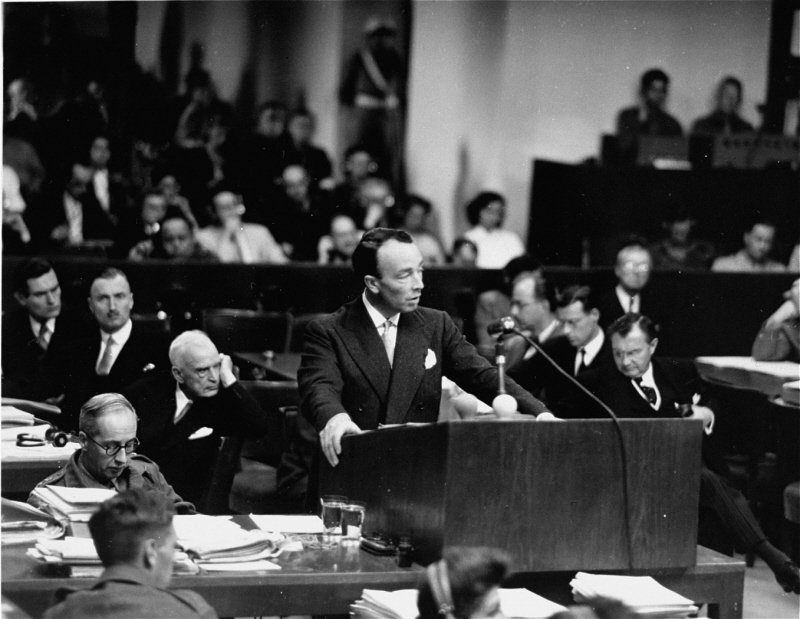
His stellar role at the Nuremberg War Crimes Tribunal was undoubtedly his finest hour. He assiduously exposed the bestial face of Nazi Germany and his punch line was ‘There comes a point when a man must refuse to answer to his leader if he is also to answer to his own conscience.’ In his opening statement, which lasted 8 hours spread over two days, he said in ringing tones, ‘And so we believe that this Tribunal..with complete and judicial objectivity, will provide a contemporary touchstone and an authoritative and impartial record to which future historians may turn for truth, and future politicians for warning. From this record shall future generations know not only what our generation suffered, but also that our suffering was the result of crimes, crimes against the laws of peoples which the peoples of the world upheld and will continue in the future to uphold—to uphold by international co-operation..and firmly grounded, in the rule of law.’ In his closing masterpiece statement, Shawcross argued, ‘That these defendants participated in and are morally guilty of crimes so frightful that the imagination staggers and reels back at their very contemplation is not in doubt..Total and totalitarian war, waged in defiance of solemn undertakings and in breach of treaties; great cities, from Coventry to Stalingrad, reduced to rubble, the countryside laid waste, and now the inevitable aftermath of war so fought – hunger and disease stalking through the world; millions of people homeless, maimed, bereaved..Not in battle, not in passion, but in the cold, calculated, deliberate attempt to destroy nations and races, to disintegrate the traditions, the institutions and the very existence of free and ancient States.’ The well known British author and journalist Rebecca West, who was at Nuremberg, described Shawcross’ closing statement as ‘full of a living pity which gave the men in the box their worst hour.’
As Attorney-General, Shawcross prosecuted the Irish-American Nazi propaganda broadcaster William Joyce (‘Lord Haw-Haw’) and the British fascist John Amery (son of the Gorakhpur born British politician and Secretary of State for India and Burma Leopold Charles Maurice Stennett Amery) for treason, the German born British nuclear scientist Klaus Fuchs and the British physicist Alan Nunn May for leaking atomic secrets to the Soviet Union, and the ‘acid bath murderer’ John George Haigh for ghastly serial killings. From 1945 to 1949, Shawcross was the principal British delegate to the United Nations at a time when the cold war was reaching its iciest phase. Labour was returned to power at the 1950 general election with a slender majority. From April 1951 until the party’s defeat that autumn, Shawcross was President of the Board of Trade. After the Tories won again in 1955, he nearly crossed over to the Tories prompting the firebrand British statesman and Labour leader Ernest Bevin to give him the uproarious sobriquet ‘Sir Shortly Floorcross’! In 1958, he threw in the towel, not only as a politician but also as a lawyer. He resigned his seat, allowed his party membership to lapse, and then withdrew from legal practice. He was made one of Britain’s first life peers on 14th February, 1959 as Baron Shawcross of Friston, and sat in the House of Lords as a cross-bencher. He sat on the boards of an incredible range of companies, including Hawker Siddeley, Shell, Times Newspapers, Dominion Continental Bankers and Thames Television. In 1957, he was among a group of eminent British lawyers who founded JUSTICE, the human rights and law reform organisation, and became its first chairman. In 1961, he was appointed Chairman of the Second Royal Commission on the Press. From 1965 to 1994, he was a special adviser to Morgan Guaranty Trust of New York. He was instrumental in the foundation of the University of Sussex and was appointed its Chancellor in 1965. In 1969, Shawcross took on the chairmanship of the Panel on Takeovers and Mergers. On 26th January,1974, his second wife Joan Winifred tragically fell from a horse and died. From 1974 to 1978, he was the Chairman of the Press Council and was described as ‘forthright in his condemnation both of journalists who committed excesses and of proprietors who profited from them’ and ‘a doughty defender of press freedom’ In the 1974 New Year Honours List, Shawcross was appointed a Knight Grand Cross of the Order of the British Empire. In 1983, Shawcross joined the newly formed Social Democratic Party. In an interview with the Palestinian born businessman and writer Naim Ibrahim Attallah in 1992, he remarked, ‘I feel that I’ve had a happy life, not a very useful life, but a happy one.’ In 1995,he published his memoirs entitled ‘Life Sentence’ looking back nostalgically on his chequered career. On 18th April,1997, he married his long time companion Susanne Monique Huiskamp in Gibraltar.
The ‘best–looking man in English public life’ died at his magnificent home at Cowbeech, East Sussex, on 10th July,2003 at the age of 101. At his memorial service, Queen Elizabeth was represented by the former Cabinet Minister Baroness Trumpington, whose father Major Arthur Campbell-Harris, an officer in the Bengal Lancers, was aide-de-camp to the Viceroy of India. In an obituary published on 11th July,2003, the Times, London, paid him a glowing tribute – ‘Shawcross was an advocate of quite exceptional calibre…In conducting his cases he was amiable and even bland. He smiled readily, and gave the impression of thinking that everyone in court was really quite a good fellow, and that the other side was mistaken or misguided, rather than wicked. When his cross-examination was at its most disruptive, his beautifully modulated voice (often described as “golden”) remained quiet and polite. He seldom became angry, and he never aped G. K. Chesterton’s huckster, who, “mocking holy anger, painfully paints his face with rage”. To his exemplary court manner (and manners) Shawcross added the power of lucid exposition, an ability to winnow the essential from the peripheral, and tremendous reserves of concentration and endurance. With this combination of talents, it was not surprising that he was soon widely acknowledged as the finest advocate of his generation.’
by ANOOP BOSE, Advocate, Supreme Court of India
E-mail : bose.anoop@gmail.com